
Profile
Two children grow up in the same Indonesian village and finish the same number of years of school. Decades later, a year of that schooling pays one of them more than four times what it pays the other. The difference: one of them grew up poor.
I study how poverty persists. Sometimes it is inherited, as in Indonesia, where growing up poor quietly lowers what every later year of schooling delivers. Sometimes it arrives in a single season, as in Mongolia, where one extreme winter pushed herding families into poverty that the national statistics never saw. I am a PhD candidate in economics at the University of Groningen (expected 2027), and these two questions anchor my dissertation.
Before and alongside the PhD, I spent more than five years as a consultant economist with the World Bank, working on poverty assessments, crisis monitoring, and large-scale household surveys, from instrument design and fieldwork through to published microdata. The policy work taught me which questions matter; the PhD is teaching me how to answer them credibly.
Primary fields: Development economics; Poverty & inequality; Labour & education economics; Climate shocks & household welfare.
Secondary fields: Behavioral & experimental economics; Applied microeconometrics.
Job Market Paper
Poverty amid Progress: The Hidden Cost of a Cold Shock in Mongolia
Abstract
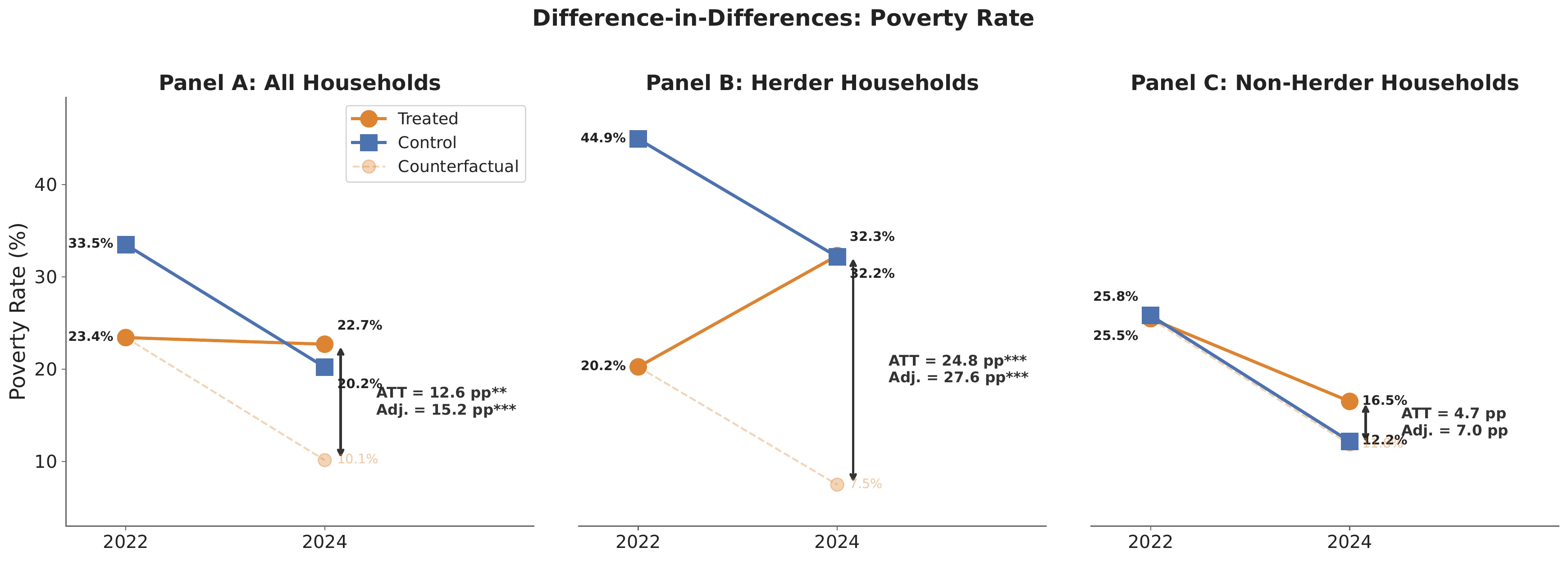
Mongolia’s 2023/24 extreme winter, a dzud, killed one in seven of the country’s livestock; over the two years that bracket it, poverty fell steeply even outside the capital, where one household in three herds for a living. Using the first nationally representative household panel to span a major dzud, we compare severely affected with less affected districts in difference-in-differences, and herders with their non-herding neighbors in a triple difference. Without the shock, poverty in severely affected districts would have fallen about 15 percentage points further and consumption would have been about 13 percent higher. The burden fell hardest on herders, whose poverty rose about 21 percentage points more than that of their non-herding neighbors and whose herds ended the winter a third smaller, through mortality rather than sale. The shock reached non-herders through food markets, where the share reporting food insecurity rose by about 80 percent of its baseline level and caloric intake fell about 12 percent. In both groups the poorest households lost most, and for non-herders poverty deepened without the headcount moving. The implied consumption loss ran four to six times the state’s emergency spending. An anticipatory transfer to every exposed herder household, at the amount trialed before an earlier dzud, would have cost less than that response. As weather extremes grow more frequent, so does the risk that losses like these vanish into improving national averages.
Key figure
Research
Working Papers
The Long Shadow: Childhood Poverty and the Returns to Education
Abstract
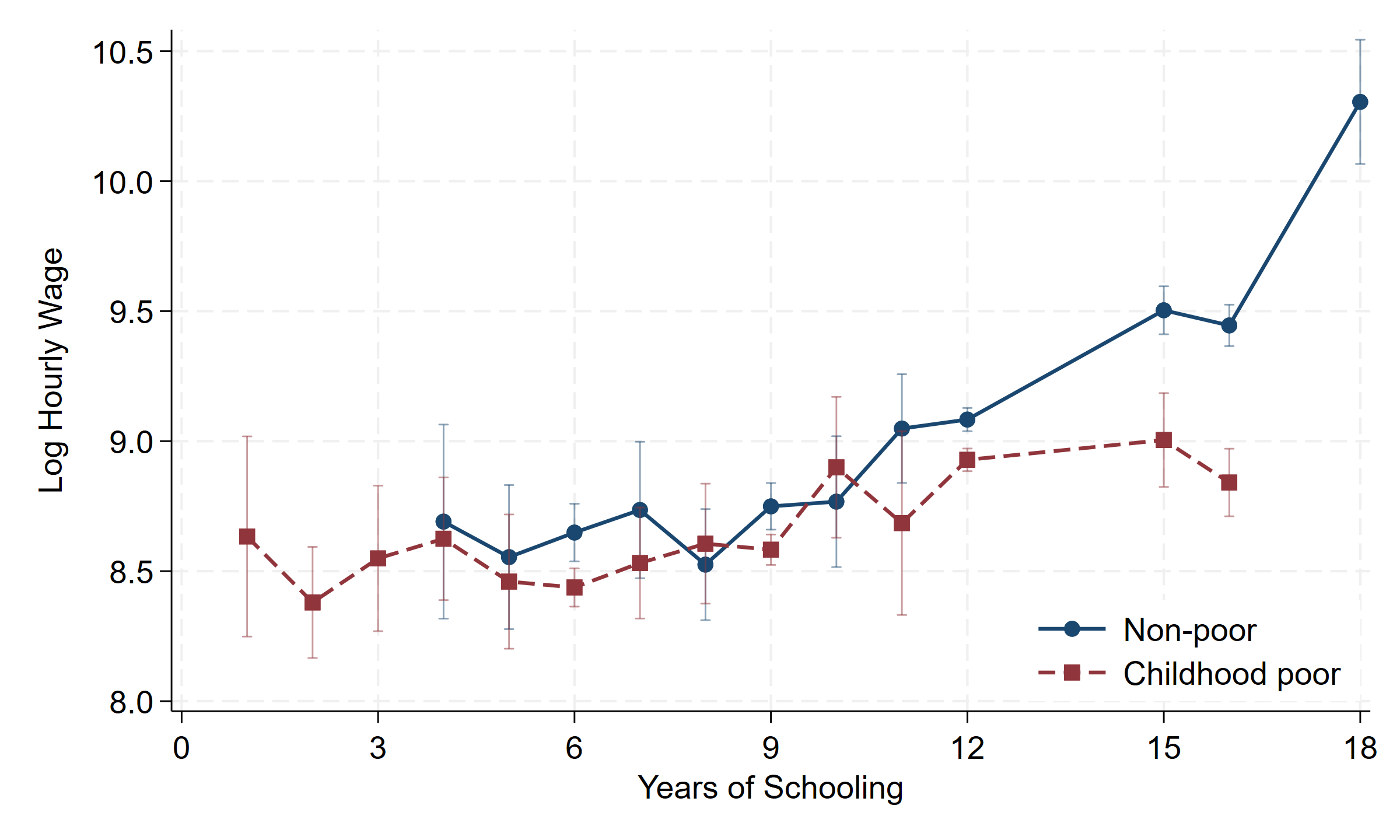
This study documents substantial heterogeneity in returns to education by childhood poverty status among Indonesian wage workers aged 15–35. Individuals who grew up poor earn only 1.5 percent per additional year of schooling, less than one-fourth of the 6.8 percent earned by those who were never poor. We estimate these returns using a control-function approach that exploits conditional heteroskedasticity for identification in the absence of exclusion restrictions. The control-function coefficient is three times larger among the poor, indicating markedly stronger positive selection into schooling in this group: only individuals with exceptionally favorable unobserved characteristics attain higher levels of education. We also present descriptive evidence of lower skill accumulation per year of schooling and more limited access to high-paying jobs among disadvantaged individuals, patterns consistent with lower marginal returns. These findings highlight the limited equalizing role of education, measured here by years of schooling.
Key figures
Work in Progress
- What the Children of the Poor Inherit: Decomposing the Poverty Penalty in Indonesia — third dissertation chapter, in progress. Indonesians whose families were observed poor during their childhood, in the Indonesia Family Life Survey’s own waves rather than by later recall, consume and earn less as adults than matched peers who never were. The chapter asks how much of that gap runs through what poverty did to them (schooling, skills, health) and how much through what they inherit around them (capital, networks, prices), using matching, mediation, and formal sensitivity analysis.
Selected Presentations
- The Long Shadow — Asian Economic Development Conference (AEDC), ADB & ADBI, HKUST, Hong Kong, Jun 2026.
- Poverty amid Progress — FEB PhD Conference, University of Groningen, Apr 2026.
- The Long Shadow — Dutch Economists Day (NED), Leiden University (The Hague), Oct 2025.
- The Long Shadow — Frontiers of Causal Inference & Machine Learning (CIML), IMT Lucca, Jul 2025.
Data & Survey Work
A core part of my work is running large household surveys end-to-end with World Bank teams: designing instruments, managing fieldwork across phone, face-to-face, and hybrid modes, and cleaning, documenting, and publicly disseminating the resulting microdata. Together we have carried this through multiple survey rounds covering thousands of households.
Software
Teaching
- Tutorial Instructor, Empirical Methods of Economics — University of Groningen, Fall 2026 (incoming). Teaching a tutorial for the course (course led by Prof. dr. Viola Angelini). Session materials.
- Lecturer, Applied Econometrics — Prasetiya Mulya Business School (international undergraduate program), 2019–2022. Panel models, difference-in-differences, discrete-choice models, robust inference.
- Lecturer, Statistics for Business Decision — Gadjah Mada University (pre-MBA, international class), 2019–2020.
Curriculum Vitae
Contact
If you work on poverty, mobility, education, or climate and development, I would be glad to hear what you are working on, and to find where the work overlaps.
Faculty of Economics and Business, University of Groningen, The Netherlands
a.febriady@rug.nl · febriadyade@gmail.com
LinkedIn · ORCID · GitHub
References
- Viola Angelini — University of Groningen (PhD supervisor) — v.angelini@rug.nl
- Agnieszka Postepska — University of Groningen (PhD supervisor) — a.postepska@rug.nl
- Lydia Kim — The World Bank (coauthor; team leader) — ykim14@worldbank.org
- Ririn Purnamasari — The World Bank (team leader) — rpurnamasari@worldbank.org
- Abigail Barr — University of Nottingham (MSc thesis supervisor) — Abigail.Barr@nottingham.ac.uk
- Sudarno Sumarto — SMERU Research Institute (team leader at TNP2K) — ssumarto@smeru.or.id
- Elan Satriawan — Universitas Gadjah Mada (team leader at TNP2K; BSc thesis advisor) — esatriawan@ugm.ac.id